How do I plan IT help desk staffing?

Listen to this blog as a podcast

.avif)
Staff for the patterns your ticket data already shows you. According to Fixify's 2026 IT Help Desk Benchmark Report, based on 50,000+ tickets across 30+ organizations over 14 months, help desk demand follows predictable rhythms across the day, week, and year. Tuesday is the busiest day. July is the busiest month. And nearly half the week's volume is compressed into just two days. Knowing these patterns turns staffing from a guessing game into a capacity plan.
Tuesday is the busiest day of the week — not Monday
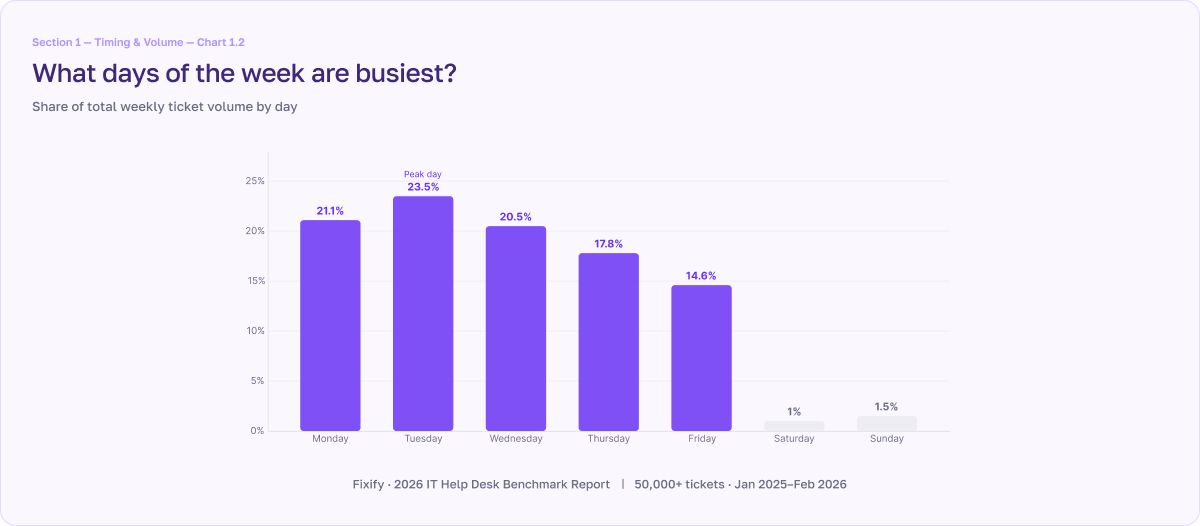
Tuesday carries 23.5% of weekly volume. Monday and Tuesday together account for 45%.
Monday gets the reputation, but Tuesday gets the tickets. In the benchmark data, Tuesday accounts for 23.5% of all weekly ticket volume, making it the single busiest day. Monday is close behind at 21.1%. Together, those two days carry 45% of the entire week's demand.
The Tuesday spike isn't random — it's a delayed effect. Employees discover a problem on Monday, try to self-resolve or work around it for a few hours, and then file a ticket Tuesday morning when they've given up. Monday brings the problems. Tuesday brings the tickets.
From there, volume declines steadily. Wednesday sits at 20.5%, Thursday drops to 17.8%, and Friday falls to 14.6% — roughly 30% below the Monday-through-Thursday average. Weekends are nearly zero at 1.0% Saturday and 1.5% Sunday.
The front-loaded week has a direct staffing implication: if your analyst coverage is spread evenly across five days, you're understaffed on Tuesday and overstaffed on Friday.
The peak hour is 11am, not 9am
The 10am–1pm window accounts for 31% of daily volume — nearly 1 in 3 tickets arrives during these three hours.
If you had to guess the peak hour for help desk tickets, you'd probably say 9am. Employees arrive, fire up their laptops, discover something's broken. But the actual peak is 11am. Volume builds through the morning, crests just before lunch, then tapers through the afternoon and drops sharply after 5pm.
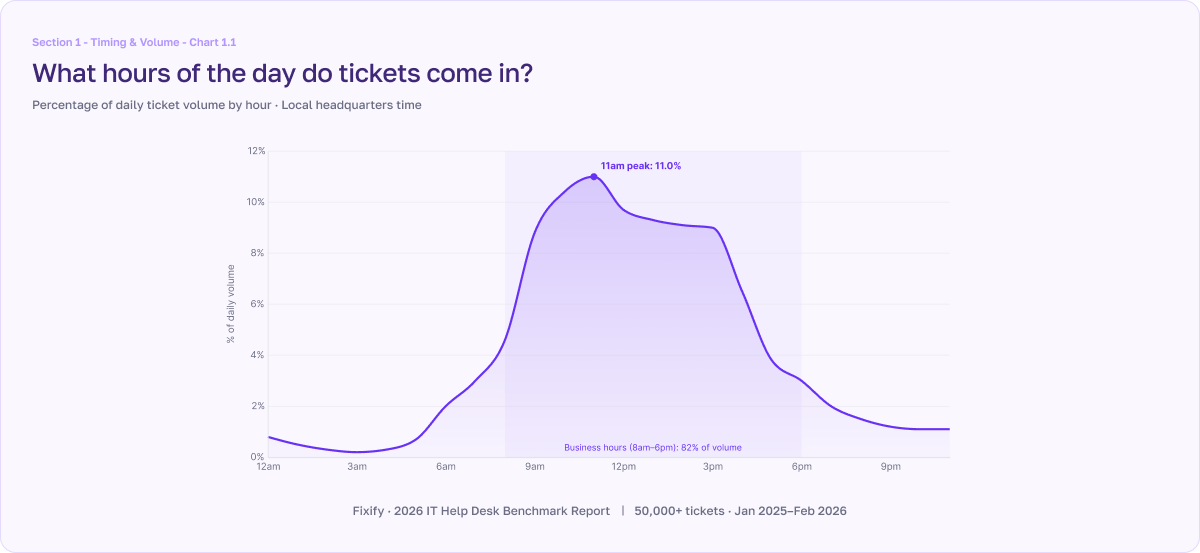
In total, 76% of all tickets arrive between 9am and 6pm Monday through Friday. The concentration is consistent across company sizes. Across the board, companies are seeing 77-80% of tickets arrive during business hours.
The practical implication: help desks that staff symmetrically across 9-to-5 are misaligned with demand. Consider front-loading coverage toward mid-morning, when employees are hitting their first friction points of the day.
July is the busiest month — and February is the quietest
July runs 29% above the average month. February and March run 20–24% below.
The seasonal pattern is just as pronounced as the weekly one. July is the busiest month in the dataset, running 29% above an average month. The mid-summer spike reflects summer onboarding cycles, mid-year access reviews, and a general uptick in hardware issues as employees work from different locations. September and October stay elevated at 12–13% above average, consistent with the back-to-work pattern after summer.
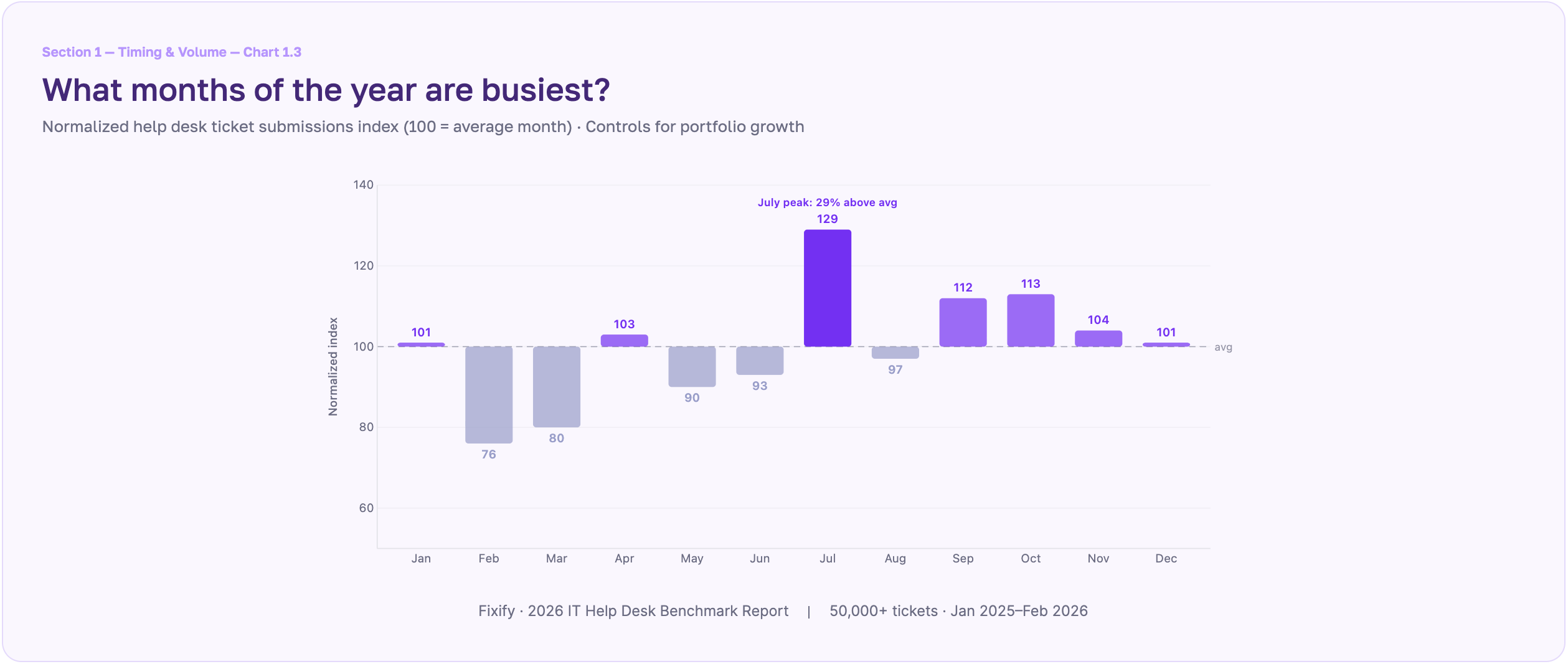
The flip side: February and March are consistently the quietest stretch. February runs 24% below average, and March 20% below. The post-holiday slowdown is real and it persists through early spring.
For IT leaders, this is a planning gift. Use the late-winter lull for infrastructure projects, system migrations, and training. Plan for July before it arrives — not while you're drowning in it. And if your organization follows a heavy hiring cycle in summer, expect onboarding tickets to compound the seasonal surge.
24% of tickets arrive outside business hours
A ticket that arrives at 7pm on Friday sits for roughly 62 hours if you only staff 9-to-6.
About 1 in 4 tickets comes in after 6pm or on weekends. Off-hours tickets skew toward provisioning and access requests rather than break-fix issues. But they still sit in the queue, and they're waiting when your team walks in Monday morning.
The math is stark: if you only staff 9am to 6pm Monday through Friday, a ticket that comes in at 7pm on Friday doesn't get touched until Monday morning. That's 62 hours. Even if it's not a critical issue, it throws your Monday metrics into chaos and creates a backlog that cascades into Tuesday, your busiest day.
This doesn't mean you need 24/7 staffing. But you should think about after-hours coverage intentionally. Some organizations use ITSM routing to handle it — VIP recognition that routes critical tickets to on-call, or end-of-quarter escalation paths for sales teams who are submitting CRM requests at 9pm. The goal isn't covering every hour equally. It's making sure that a ticket submitted at the wrong time doesn't become a three-day wait by accident.
How to align staffing to demand
The patterns in this data are consistent enough to plan around. Here's where to start:
- Front-load your week. Weight analyst coverage toward Monday and Tuesday, when 45% of weekly volume lands. Consider moving recurring team meetings to Friday afternoons — that Monday 10am standup pulls your people out of the queue at exactly the moment demand is highest.
- Plan around the calendar. Use the February–March lull for infrastructure work, training, and anything else that benefits from lower baseline volume. Plan for July's surge in advance — ensure full coverage and avoid scheduling major rollouts during the busiest month of the year.
- Be deliberate about after-hours. You don't need to staff overnight, but you do need a plan for what happens to tickets that arrive outside business hours. Smart ITSM routing — escalation paths based on ticket type, requester role, or time sensitivity — can cover the gap without adding headcount.
For the full hourly, daily, and monthly demand data, download Fixify's 2026 IT Help Desk Benchmark Report at fixify.com/it-help-desk-benchmark-report-2026.
Related articles

What is service desk software? Features, benefits, and use cases
.avif)
The hidden cost of untracked IT work (and how to fix it)

Scaling up Okta Workflows: What IT teams learn after the first 10 flows

Stay in the loop

Sign up to get notified about our latest news and blogs