.svg)
.svg)
Why machines should stay in service of humans as AI goes always-on
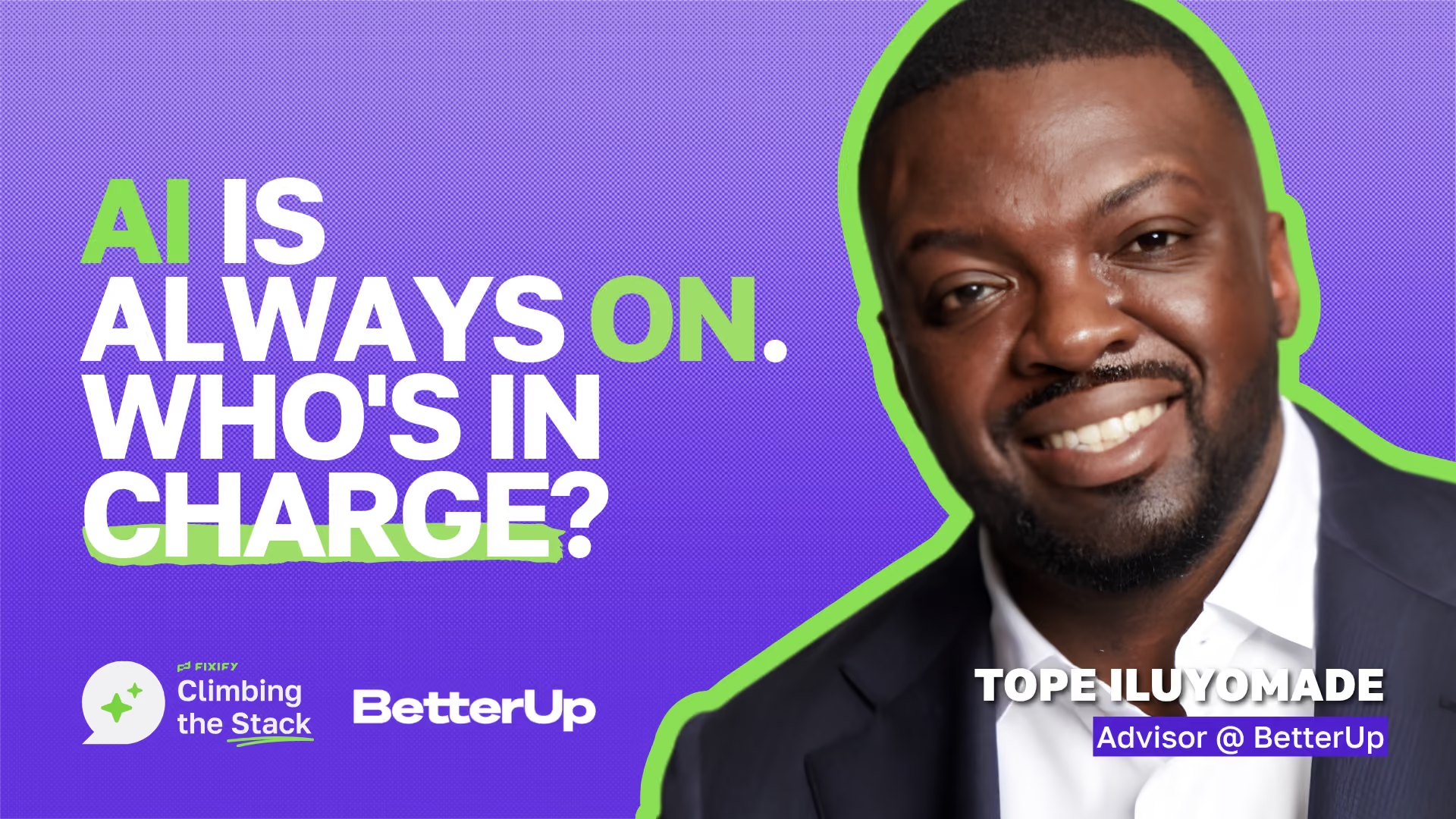
Table of contents


About this episode
AI is always on, which raises a hard question about who's in charge. Tope Iluyomade, former CIO and CISO and now Advisor at BetterUp, has a clear answer: machines should stay in service of humans. Before you build something, a person rather than a model should weigh whether the consequences are worth it. The harder question is always whether you should build it, beyond whether you can.
That view comes from a career spent where mistakes are costly. Tope came up through defense and aviation, where errors get measured in body count, then fintech, where velocity is prime but velocity is blind. He sees the job of a CIO and CISO as teaching companies how to do dangerous things carefully, and his test for any new technology is whether the glass has a handle.
"Policies are meant to throttle the introduction of technology. So we have a handle around it."
He also walks Matt Peters through the climb to the C-suite. A director gets paid to provide answers with certainty, while a C-suite leader has to act at 51 percent certainty and build the operating system that helps a company keep making good decisions. Tope earns trust by opening his work up to scrutiny instead of defending it, a habit he traces back to academic peer review. He learned finance as a fly on the wall in CFO meetings, until he understood that CFOs want an investment case rather than a technology lecture.
Tope connects his earlier supply chain optimization work for Unilever, Pfizer, and Merck to why he joined BetterUp. Every efficiency gain eventually displaces workers, and someone has to build the loop that reskills them. He closes with a lesson from time spent with Holocaust survivors: you only get about 80 summers, so swing for the fence.
"The journey is better to go with people than to go it alone."
What you'll learn in this episode
- Why AI guardrails belong at inception, not bolted on later
- How to weigh whether you should build something, beyond whether you can
- How to teach a company to do dangerous things carefully
- What it means to ask whether the glass has a handle
- How to lead at 51 percent certainty in the C-suite
- How to learn finance as a fly on the wall with CFOs
- Why every efficiency gain needs a reskilling loop
- Prom and recess: How to give problems to the right level
About Tope Iluyomade
Tope Iluyomade is a former CIO and CISO, now Advisor at BetterUp, where he leads security and business technology and heads the company's work on AI security and ethics. He has spent his career guiding organizations from startups to publicly traded companies on security, risk, data privacy, and responsible AI.
Before BetterUp, Tope was VP of Business Technology at Marqeta and held CISO and enterprise technology roles at Aera Technology, plus earlier positions at Yapstone, Alaska Airlines, General Dynamics, and GE. He began as an NSF machine learning researcher and holds bachelor's and master's degrees in Computer Science from the University of Maryland, Baltimore County, specializing in machine learning.
Resources mentioned
About the host
Matt Peters is the CEO and Co-Founder of Fixify, where he's redefining the IT help desk for the AI era. Before founding Fixify, he was Chief Product Officer at Expel and held senior leadership roles at FireEye and Mandiant, where he helped pioneer some of the earliest managed detection and response services.
Episodes you might like
Why human care still wins in an AI world
Matt Peters, CEO and Co-Founder of Fixify, joins Joey Pinz to explain why AI should help talented technicians do more meaningful work, not replace them.
Don't break into jail: How to present technology to the board
Brad Lontz, EVP and CIO at CSAA Insurance Group, explains why he keeps no separate AI strategy and how he learns a new business through its value chain instead of starting with the CFO.
Trust your gut: The leadership advice I'd give my younger self
Darragh Curran, CTO and Head of Engineering at Fin, explains why writing code has become the easy part of building software and why he hires for traits over experience.

Join us as a guest!
