.svg)
.svg)
The 90-day framework that moved IT from whack-a-mole to strategic execution
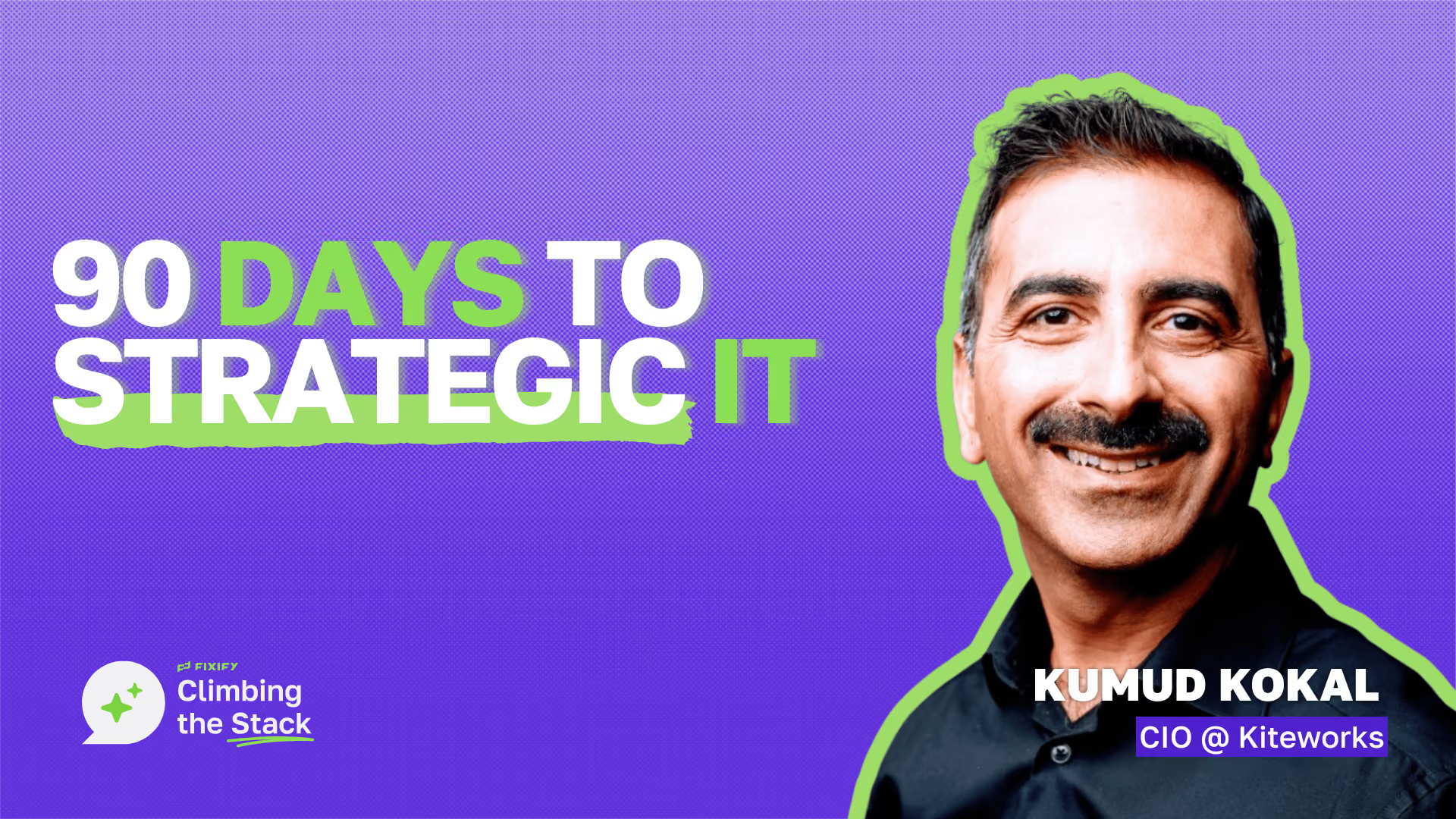
Table of contents


About this episode
When Kumud Kokal took over IT at Farmers Business Network, his team was playing whack-a-mole. There was no mission, vision, or strategy, just reactive firefighting. In his first 90 days, he turned that into a one-slide constitution that every initiative had to align with before it received funding.
The process started with listening. For his first 30 days, Kumud asked his team five questions: What's working well? What's not? What are the opportunities? Who are the key stakeholders? What are the key projects? He asked stakeholders nearly the same questions, plus two more: What's IT's brand from your perspective? What's the one thing we could do to accelerate your productivity?
Then he mapped both sets of answers as overlapping Venn diagrams.
"When I get this inside out and outside in picture, think of those as two Venn diagrams you overlay. In an ideal world, those two circles should just overlay completely on top of each other. That never happens."
The overlap showed what was working. The gaps showed where his team thought it was delivering value that stakeholders didn't recognize, and where stakeholders needed support the team didn't know about. At FBN, the gaps revealed a team executing flawlessly on work stakeholders didn't prioritize. Kumud used his final 30 days to build the mission-vision-strategy slide, which opened every monthly all-hands from then on.
He also walks Matt Peters through his path from accounting to software engineering to CIO, across Intuit, Airbnb, Stitch Fix, FBN, and now Kiteworks. Along the way, he built a personal board of directors, with different mentors for compensation, technical, and industry questions. At Intuit, he learned the "follow me home" method of watching people actually use the software. That's how his team caught a phone extension field that crashed their applicant tracking system on day two, something testing had missed.
At Kiteworks, Kumud's team has built three to four dozen AI agents through a shared responsibility model. Business units propose the problems, and IT funds the solutions and builds the infrastructure. The agents even have a family name, the Stevensons. Caroline, the HR and IT agent, works inside Microsoft Teams and knows each employee's location, department, and management hierarchy, so an employee in San Mateo asking about time off gets the California-specific answer from connected systems.
What you'll learn in this episode
- How to align IT with stakeholders in your first 90 days
- The five questions to ask your team and the two extra questions to ask stakeholders
- How to use overlapping Venn diagrams to find gaps between IT and the business
- How a one-slide mission-vision-strategy can decide which projects get funded
- Why you should build a personal board of directors with specialized mentors
- How the "follow me home" method catches what testing misses
- How a shared responsibility model helped build three to four dozen AI agents
- Why AI agents work better when they're connected to real employee context
About Kumud Kokal
Kumud Kokal is CIO at Kiteworks, bringing more than 25 years of Silicon Valley experience across consumer finance (Intuit), hospitality (Airbnb), retail (Stitch Fix), agriculture technology (Farmers Business Network), and enterprise security.
He moved from software engineering into IT leadership through Intuit's HR technology team, where he learned the "follow me home" observation method that catches what user acceptance testing misses. At Kiteworks, his CEO expects the executive team to be knowledgeable about AI and to actively promote adoption, which supports the shared responsibility model behind agents built across IT, HR, product, and marketing.
Resources mentioned
- The Five Dysfunctions of a Team by Patrick Lencioni
- The First 90 Days: Proven Strategies for Getting Up to Speed Faster and Smarter by Michael D. Watkins
- Acquired podcast
- How I AI podcast
- Connect with Kumud Kokal on LinkedIn
About the host
Matt Peters is the CEO and Co-Founder of Fixify, where he's redefining the IT help desk for the AI era. Before founding Fixify, he was Chief Product Officer at Expel and held senior leadership roles at FireEye and Mandiant, where he helped pioneer some of the earliest managed detection and response services.
Episodes you might like
Why human care still wins in an AI world
Matt Peters, CEO and Co-Founder of Fixify, joins Joey Pinz to explain why AI should help talented technicians do more meaningful work, not replace them.
Don't break into jail: How to present technology to the board
Brad Lontz, EVP and CIO at CSAA Insurance Group, explains why he keeps no separate AI strategy and how he learns a new business through its value chain instead of starting with the CFO.
Trust your gut: The leadership advice I'd give my younger self
Darragh Curran, CTO and Head of Engineering at Fin, explains why writing code has become the easy part of building software and why he hires for traits over experience.

Join us as a guest!
