.svg)
.svg)
Every AI agent is an identity: A CISO's security sequence
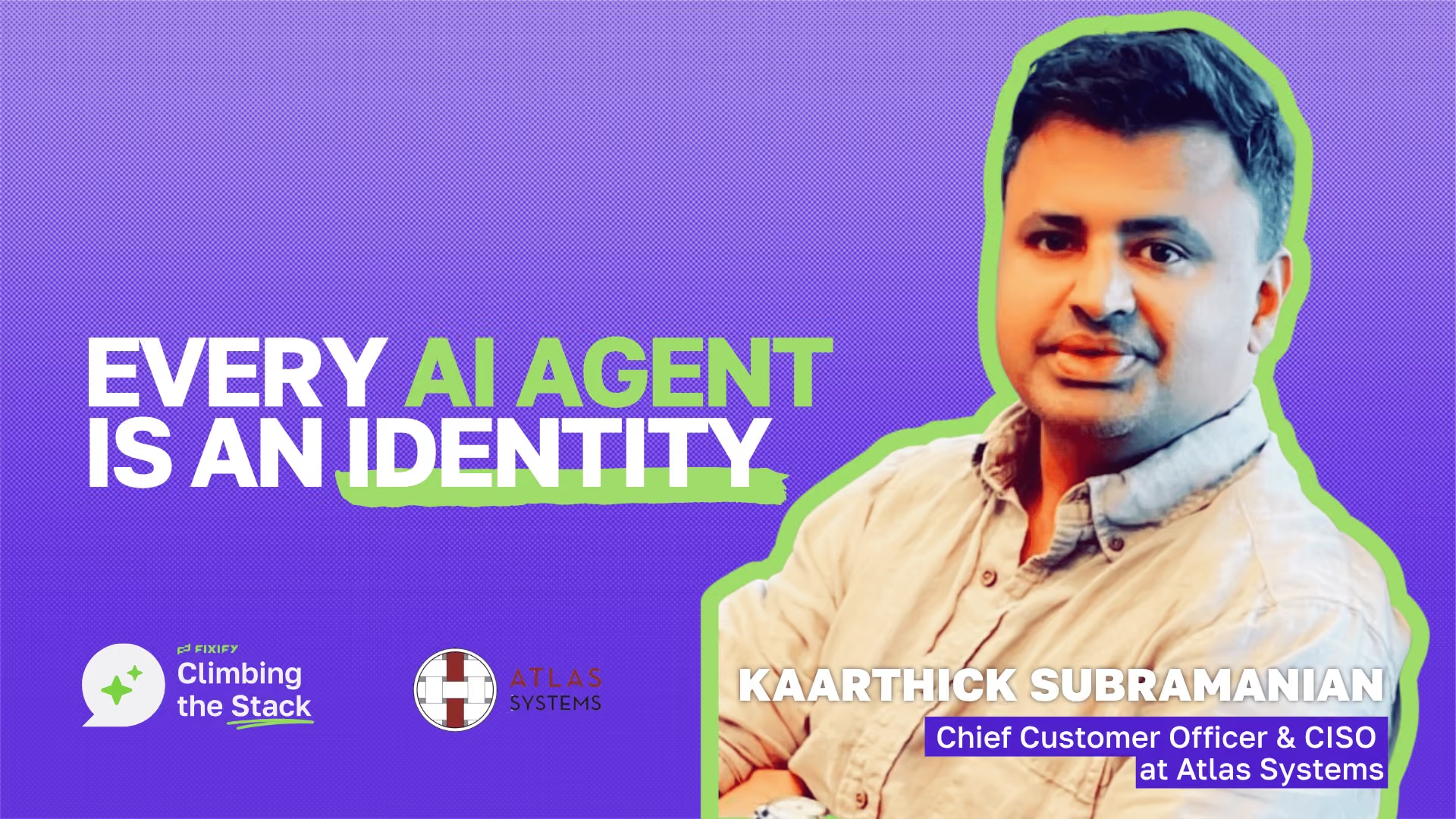
Table of contents


About this episode
Most AI initiatives don't fail on model quality. Kaarthick Subramanian, Chief Customer Officer and CISO at Atlas Systems, has watched them fail on foundations, governance, and adoption instead. A pilot can look strong right up until production readiness asks where the data lives, who approved it, and how it flows.
His fix starts with a simple rule: treat every AI agent as an identity. From there, he walks Matt Peters through the sequence he follows, starting with identity, then adding visibility and monitoring before standing up a SOC. He also explains why guardrails belong at the architecture level rather than in the prompt.
Kaarthick learned to think this way at the very start of his career. His first project as a C++ developer had to complete a payment transaction with an airplane, back when every byte of data cost money. Nobody graded how elegant his code was. They graded whether the payment went through and made business sense, and that reframed his whole career around the business problem behind the technology.
That same habit shapes how he talks about risk. Kaarthick explains how he translates technology risk into business risk for CFOs and boards, because the stakes reach well beyond the systems themselves.
"Security is not just about protecting your asset. It's about protecting the reputation and the brand of the company."
He also gets into what separates a true partner from a vendor, and his advice for going independent without a niche: do your current work well, and clients will hand you the next problem to solve. He closes on why loving your craft, rather than your company, removes the fear that keeps so many careers stuck.
What you'll learn in this episode
- Why AI initiatives fail on governance and adoption rather than model quality
- Why every AI agent should be treated as an identity
- How to sequence identity, visibility, and monitoring in AI security
- Why AI guardrails belong at the architecture level, not in the prompt
- How to translate technology risk into business risk for the board
- What separates a true partner from a vendor
- How to go independent without a perfect niche
- Why loving your craft instead of your company frees you to lead
About Kaarthick Subramanian
Kaarthick Subramanian is Chief Customer Officer and CISO at Atlas Systems, where he leads client success alongside enterprise security and AI governance for the company's AI-anchored portfolio.
He began his career as a C++ developer and went on to lead large services portfolios at companies including Polaris, DXC Technology, and Compuware. He also founded his own consulting practice, KAAS Technology, serving growth-stage and regulated businesses. He holds the CISSP certification and an MBA.
Resources mentioned
- Extreme Ownership: How U.S. Navy SEALs Lead and Win by Jocko Willink and Leif Babin
- Death: An Inside Story by Sadhguru
- Langfuse (AI agent monitoring)
- Connect with Kaarthick Subramanian on LinkedIn
About the host
Matt Peters is the CEO and Co-Founder of Fixify, where he's redefining the IT help desk for the AI era. Before founding Fixify, he was Chief Product Officer at Expel and held senior leadership roles at FireEye and Mandiant, where he helped pioneer some of the earliest managed detection and response services.
Episodes you might like
Why human care still wins in an AI world
Matt Peters, CEO and Co-Founder of Fixify, joins Joey Pinz to explain why AI should help talented technicians do more meaningful work, not replace them.
Don't break into jail: How to present technology to the board
Brad Lontz, EVP and CIO at CSAA Insurance Group, explains why he keeps no separate AI strategy and how he learns a new business through its value chain instead of starting with the CFO.
Trust your gut: The leadership advice I'd give my younger self
Darragh Curran, CTO and Head of Engineering at Fin, explains why writing code has become the easy part of building software and why he hires for traits over experience.

Join us as a guest!
