.svg)
.svg)
"Someone who uses AI better than you will replace you": building fluency inside IT
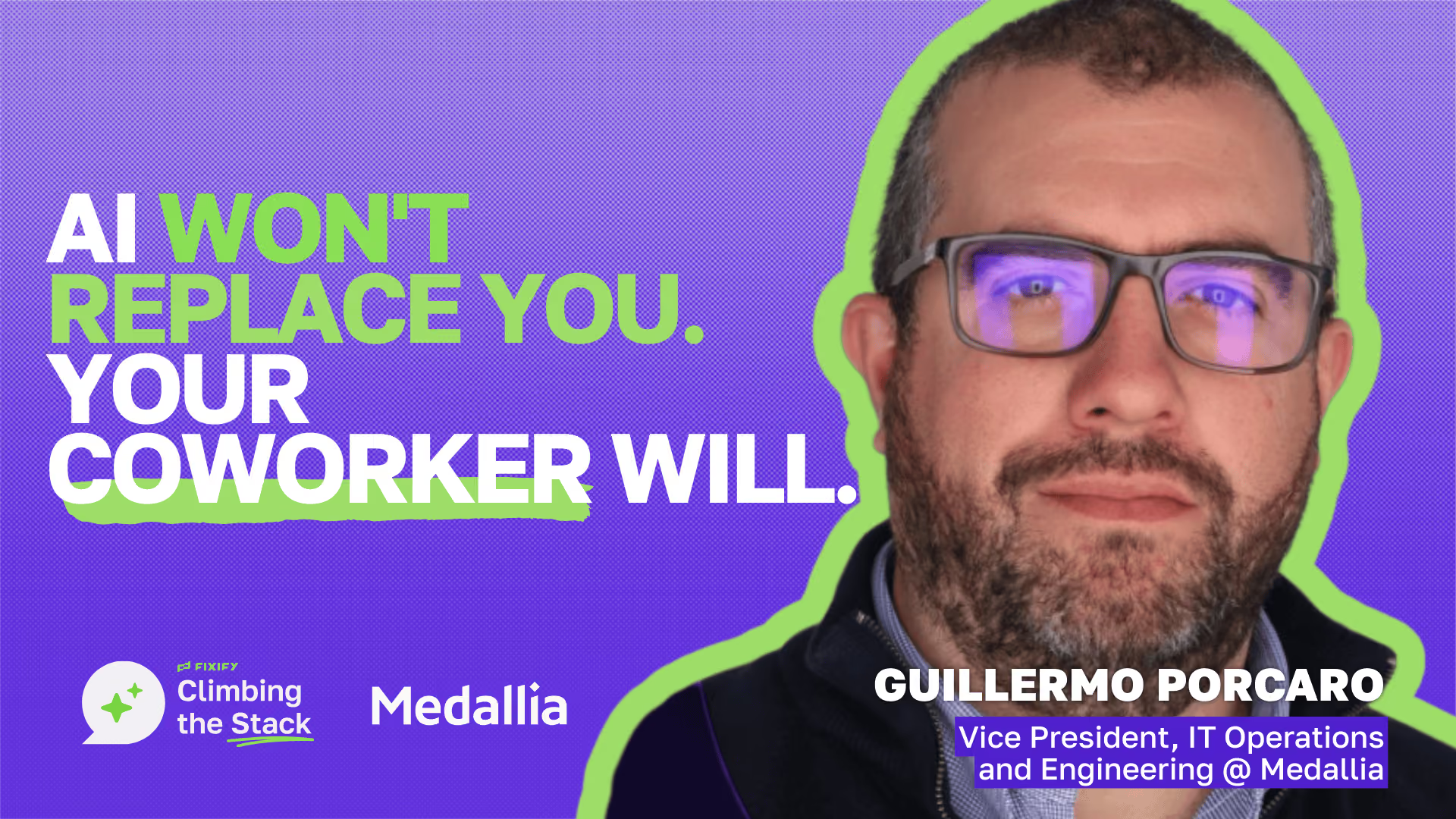
Table of contents


About this episode
AI lets an IT team build faster than it can understand what it built. Guillermo Porcaro, VP of IT Operations and Engineering at Medallia, is working through that tension right now. His line is clear: if your team can't troubleshoot something node by node, you don't actually own it.
"AI is not going to replace technology jobs, but people that know how to use AI better than you is going to replace you."
So Guillermo is building AI fluency inside his team before it becomes urgent. He gave them a dedicated environment to experiment and build hands-on, and he treats AI fluency as a personal skill each person owns. When it comes to what they build, he favors node-based agentic workflows, so that when something breaks, the team can isolate and fix it piece by piece instead of facing a black box.
He also walks Matt Peters through a reorg he funded without asking for more budget. Guillermo inherited a global IT org with contractor engagements across Asia-Pacific that didn't fit the time zones, the talent needs, or the budget trajectory. He mapped the org like a system, identified what was misaligned, and reallocated that spend toward a full-time team in Latin America, gaining better coverage at lower cost.
His career started in Buenos Aires, fixing and building computers, before he learned enterprise IT at IBM's service delivery center in Argentina. He took a step down in title to join Medallia, starting as the only IT person in its Argentina office, and once rebuilt that office's infrastructure over a single weekend. He later stepped into the VP role when leadership departed all at once.
Along the way, he learned to see how individual work moves up the chain, and he now teaches that to his team. A missed deadline on a project that feeds a program, which feeds a board-level commitment, is not a small thing.
What you'll learn in this episode
- Why someone who uses AI better than you is the real career threat
- How to build AI fluency inside an IT team before it becomes urgent
- Why your team only owns what it can troubleshoot node by node
- How node-based agentic workflows avoid black-box builds
- How AI is changing the IT team's frontline structure
- How to restructure a global IT org without adding budget
- How to apply an engineering mindset to org design and budget planning
- How to teach individual contributors to see their upstream impact
About Guillermo Porcaro
Guillermo Porcaro is Vice President, IT Operations and Engineering at Medallia. He started his career in Buenos Aires fixing and building computers before joining IBM's service delivery center in Argentina, where he learned enterprise IT processes and team structure for the first time. He went on to hold roles at Chevron and other large delivery centers before joining Medallia, initially as the sole IT resource for the Argentina office.
He has since built and restructured a global IT organization, including a self-funded reorg that shifted contractor spend from Asia-Pacific to a full-time team in Latin America, and he is actively working through how IT teams can adopt and own AI tooling without outpacing their ability to support it.
Resources mentioned
About the host
Matt Peters is the CEO and Co-Founder of Fixify, where he's redefining the IT help desk for the AI era. Before founding Fixify, he was Chief Product Officer at Expel and held senior leadership roles at FireEye and Mandiant, where he helped pioneer some of the earliest managed detection and response services.
Episodes you might like
Why human care still wins in an AI world
Matt Peters, CEO and Co-Founder of Fixify, joins Joey Pinz to explain why AI should help talented technicians do more meaningful work, not replace them.

Don't break into jail: How to present technology to the board
Brad Lontz, EVP and CIO at CSAA Insurance Group, explains why he keeps no separate AI strategy and how he learns a new business through its value chain instead of starting with the CFO.
Trust your gut: The leadership advice I'd give my younger self
Darragh Curran, CTO and Head of Engineering at Fin, explains why writing code has become the easy part of building software and why he hires for traits over experience.

Join us as a guest!
