.svg)
.svg)
A CEO sorted every employee into three AI buckets. Where would your team land?
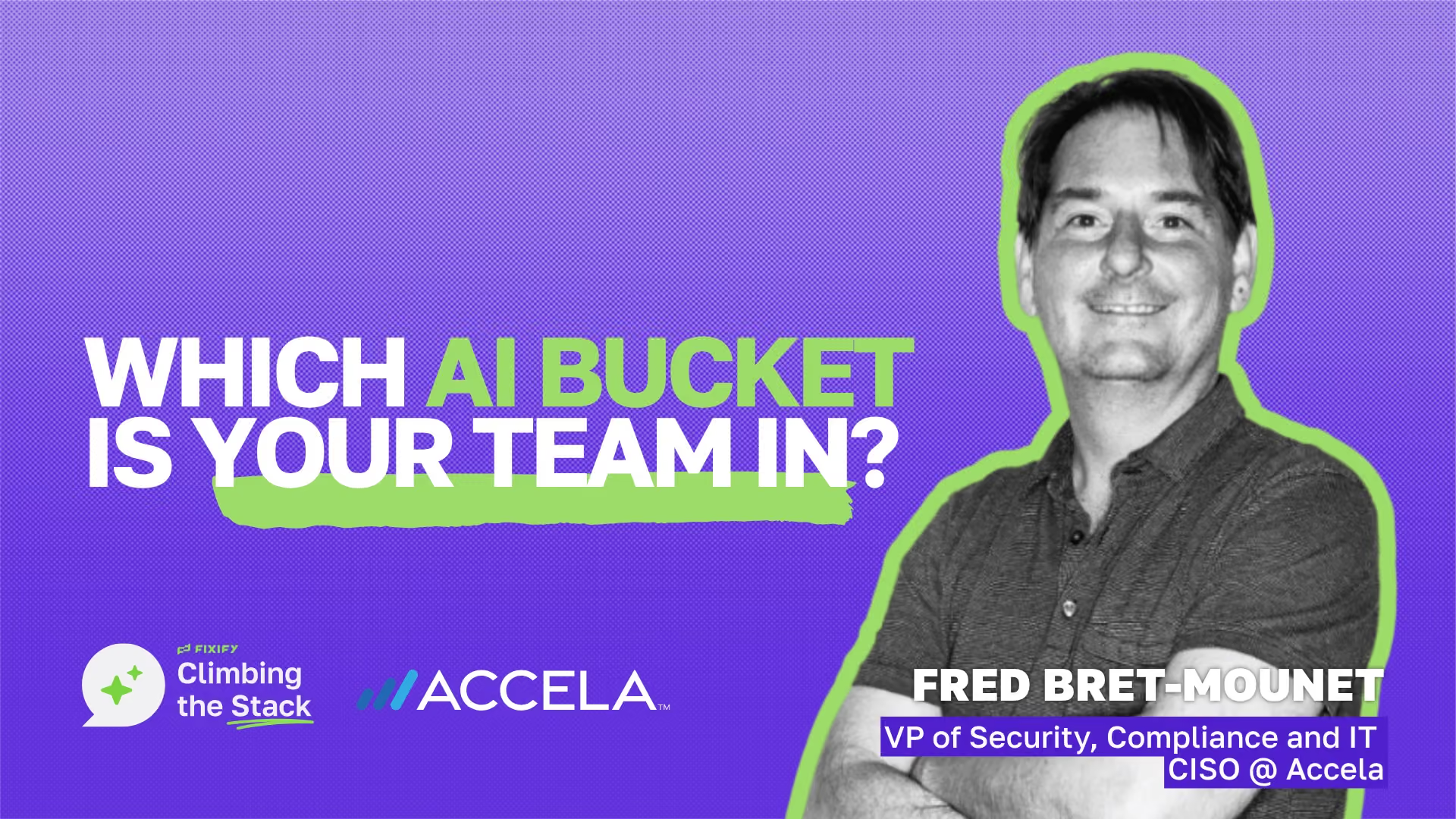
Table of contents


About this episode
Fred Bret-Mounet has reinvented himself every five to ten years since before the internet existed. Now VP of Security, Compliance and IT and CISO at Accela, he says AI has shrunk that window to six months. So when a CEO asked him to sort employees into three buckets for AI adoption, the categories were clear: forward thinkers, the trainable, and the resistance brigade. The third bucket is in trouble.
He applies the same thinking when he grades students. Turning in AI as the answer earns a failing grade, and so does skipping AI as an input.
"I will fail you if you use AI as the end product to resolve your problem."
Fred walks Matt Peters through the analogy he uses for how much to trust AI. For the last three years, his Tesla has handled about 90% of his driving with full self-driving, and he loves it. But you'll never catch him in the back seat or asleep at the wheel. Three years ago, the car made a dangerous mistake about once a week. Now it's closer to once a month, but the risk never fully goes away. Fred sees AI the same way.
"For 80% of the things you'll ask Claude to do, it will do like the Tesla and it will drive you from point A to point B with absolutely no stress and no mistakes. But if you don't pay attention, it might make one that will actually get you pretty badly."
He also explains what AI means for security teams. Organizations that don't automatically patch everything internet accessible will be dealing with breaches quarterly, if not monthly, because attackers can now reverse engineer a patch in minutes. The first line of response to security events has to be entirely automated, and phishing can no longer be caught through broken English or a false sense of urgency. It has to be detected through the intent behind the message.
Fred's path to the C-suite started in 2001 at @stake, one of the firms that invented security consulting, where he was excellent at building Fort Knox. When he moved to the receiving end of those consulting reports, he realized recommending Fort Knox at all costs was the worst advice he could give. Today, he uses the California speed limit as his framework. The sign says 65, but you can drive 85 without consequences as long as you aren't threatening anyone. Those extra miles per hour are velocity, and the CISO's job is to mark where the real line sits so the business can make an educated risk decision.
"They don't get it because you didn't explain it to them in a way that they could get it."
That's also why he sometimes publicly disavows his own team, trading a two-week fix deadline for two months when the incremental risk is insignificant, to land the right business outcome.
What you'll learn in this episode
- Why AI has shrunk reinvention cycles from a decade to six months
- How to sort a team into three AI adoption buckets
- How a Tesla analogy can help you calibrate trust in AI
- Why everything internet accessible now needs auto-patching
- Why your first line of security response has to be automated
- How to detect phishing through intent rather than message syntax
- How the speed limit framework turns security risk into business velocity
- Why a CISO sometimes needs to push back on their own team
About Fred Bret-Mounet
Fred Bret-Mounet is the VP of Security, Compliance and IT and CISO at Accela, and the founder of Bastille Security, an AI security consulting, education, and technology firm helping organizations deploy AI safely. He brings more than 20 years of cybersecurity leadership, going from AppSec engineer to CISO and building security programs from zero at three or more organizations.
He started his security career in 2001 at @stake, one of the firms that invented security consulting, and went on to security leadership roles at RelayHealth, McKesson, Change Healthcare, Syapse (HITRUST certified in nine months), and Clarify Health Solutions, where he was the first full-time CISO. He also spent five and a half years as an AppSec instructor in Merritt College's cybersecurity program.
Fred is a DEF CON and Black Hat speaker and holds CISSP, CCSK, and GSLC certifications, with an MS in Computer Science from Stevens Institute of Technology and an MS in Software Engineering from EPITA in Paris.
Resources mentioned
About the host
Matt Peters is the CEO and Co-Founder of Fixify, where he's redefining the IT help desk for the AI era. Before founding Fixify, he was Chief Product Officer at Expel and held senior leadership roles at FireEye and Mandiant, where he helped pioneer some of the earliest managed detection and response services.
Episodes you might like
Why human care still wins in an AI world
Matt Peters, CEO and Co-Founder of Fixify, joins Joey Pinz to explain why AI should help talented technicians do more meaningful work, not replace them.
Don't break into jail: How to present technology to the board
Brad Lontz, EVP and CIO at CSAA Insurance Group, explains why he keeps no separate AI strategy and how he learns a new business through its value chain instead of starting with the CFO.
Trust your gut: The leadership advice I'd give my younger self
Darragh Curran, CTO and Head of Engineering at Fin, explains why writing code has become the easy part of building software and why he hires for traits over experience.

Join us as a guest!
