
Key highlights


Real production data. Not a survey.
17,929 agentic plans and 147,351 actions from 40+ companies, analyzed over 13 weeks of live IT operations. No self-reported estimates here.

The new division of labor
See exactly how work splits between AI agents and human analysts in practice, why full autonomy isn't the goal, and what "good" supervision actually looks like.

Why most failures aren't an AI problem
Find out why roughly 3 in 4 agentic failures trace back to stale or incomplete data — and what to clean up before you scale.
What you'll learn

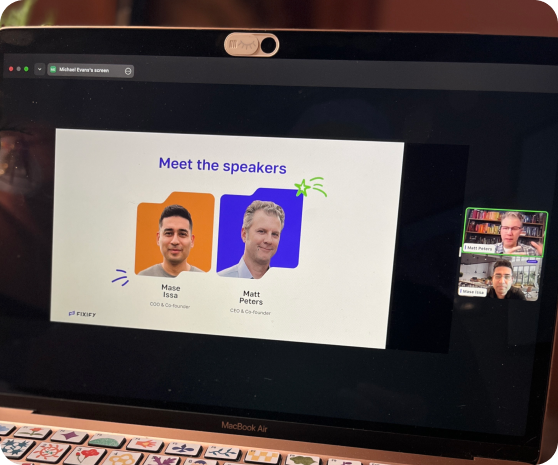
Agentic AI is changing how IT work gets done. The early evidence points to a new operating model: AI agents execute routine work while analysts supervise, approve, redirect, and step in when judgment is required. Rather than replacing IT professionals, AI is redefining how work is divided between people and machines.
In this session, Fixify's Matt Peters (CEO) and Mase Issa (COO) walk through 13 weeks of production data and show you:
- How work is actually divided between AI agents and analysts, and why supervised automation consistently outperforms full autonomy
- Why analyst approvals and rejections are the feedback loop that makes AI systems more effective over time
- Where agentic AI is delivering the most value today, and why identity and access management is the foundation for broader adoption
- Why nearly three quarters of automation failures stem from stale or incomplete data rather than model performance
- A practical framework for deciding what to automate first based on volume, predictability, and business risk
Whether you're evaluating agentic AI, building a roadmap, or looking for practical benchmarks from early adopters, you'll leave with a clearer picture of what a successful AI-enabled IT organization looks like and where to begin.
Watch the full webinar replay

Enter your details to watch on-demand